Following media coverage of a hantavirus cluster, Deep Opinion analyzed online conversations around the subject. This short but intense sequence illustrates a major transformation in the public arena: a health alert no longer circulates solely as medical information. It is immediately interpreted through the Covid’s memory, the trust placed in institutions and the reflexes specific to social networks.
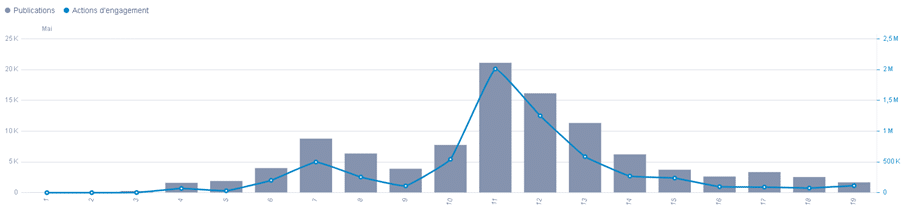
The sequence was short but intense, with 101,619 publications across all media – social networks, online media, forums, blogs and websites. Conversation peaked on May 11, with the volume of mentions multiplying by 2.7 in 24 hours, to 21,087, compared with 7,719 the previous day. In terms of engagement, the surge was even more pronounced, with almost 2 million actions, a 3.7-fold increase on the previous day.
Evolution of the volume of hantavirus-related publications and engagements
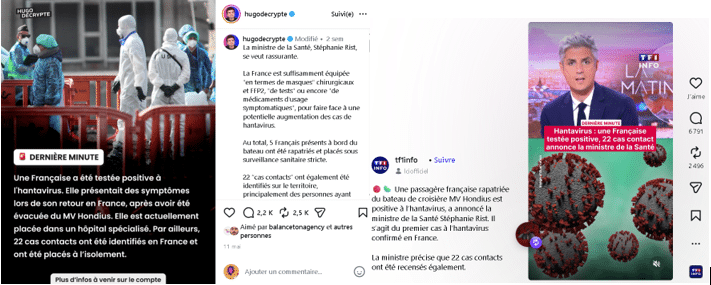
Initially, the conversation is structured around an informative framework: the MV Hondius ship, the passengers involved, health measures and the risk of contagion. Online media and major news accounts (such as HugoDécrypte, AlertesInfos, TF1 Info or Brut) then help raise the profile of the subject among the general public.
But once relayed on social platforms, notably X, which accounts for over 60% of the publications analyzed, the alert changes in nature. It becomes the medium for more emotional expressions: concern, anger, irony, suspicions of media dramatization, comparisons with other viruses or evocations of a “new pandemic”.
The sequence is then taken up by actors with more critical framings, media-political figures such as Florian Philippot or Myriam Palomba, who inscribe it in already available controversies: distrust of the media, criticism of public risk management, questioning of health institutions or references to post-Covid debates on vaccines and messenger RNA.
Above all, the hantavirus is quickly reread through the memory of Covid: nearly 14% of publications explicitly cite Covid or coronavirus, and around a quarter of the corpus mobilizes vocabulary associated with the health crisis: pandemic, containment, mask, vaccine, antivax or messenger RNA. In other words, the hantavirus is quickly read through the interpretive grids inherited from the Covid period.
This re-reading also feeds more explicit forms of distrust: almost 10% of publications mobilize markers of distrust or disinformation, around themes such as “propaganda”, “manipulation”, “plandemic”, “Big Pharma” or the supposed role of the WHO.
Since Covid, every health alert has had to pass through a double filter: that of its scientific credibility, but also that of trust in the institutional, media and political players who make it visible.