
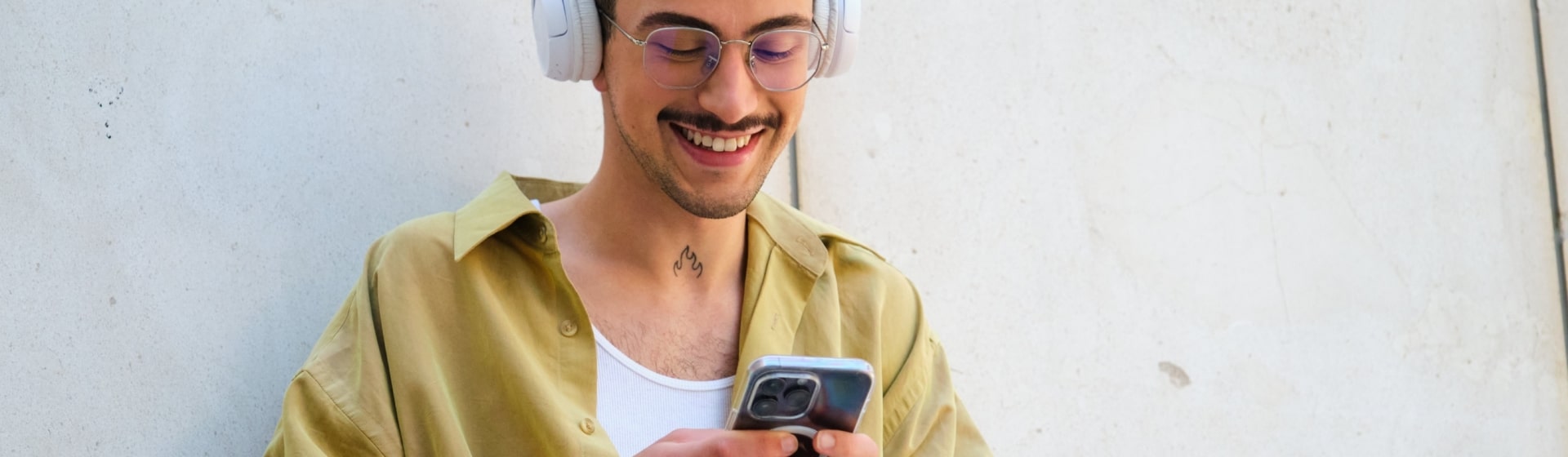
The widespread use of earbuds and time spent in noisy environments now play a major role in young people’s daily lives: the 2024 JNA-IFOP Tinnitus Barometer survey found that one in fifteen teenagers spends more than 5 hours a day wearing headphones or earbuds. In this context, the survey conducted for the Fondation pour l’Audition highlights a marked disconnect between a theoretical awareness of hearing risks and behaviors that, in practice, remain highly risky.
Real knowledge, but clouded by misconceptions that downplay the risk
Young people generally appear well-informed: 94% acknowledge that hearing loss can occur at a very young age, 87% correctly identify noise exposure as the leading cause of hearing problems, and only 12% still believe that it affects only older adults. However, several misconceptions persist and act as implicit barriers to prevention: 63% believe that a sound is only dangerous once it becomes painful, even though hearing damage can occur long before that. 28% underestimate the cumulative effect of moderate volume levels, 20% believe that people get used to noise, and 19% think that hearing loss can be reversed.
Widespread risky behaviors, centered on the use of earbuds
More than one in two young people (52%) admit to taking risks with their hearing—an awareness that increases with age (55% of 22- to 24-year-olds versus 48% of 15to 18-year-olds) and peaks among high school graduates (62%). The use of personal audio devices is associated with the riskiest behaviors: 65% often use their headphones in already noisy environments, 64% listen to music for long periods without a break, 58% listen at high volumes, and 57% turn up the volume to drown out ambient noise. Behaviors related to going out (37% attend concerts, parties, or festivals without protection) remain significant, and 28% of young people continue to expose themselves to loud sounds even after experiencing hearing discomfort.
This risky behavior is compounded by an overwhelmingly noisy everyday environment: 59% of young people say they are often exposed to particularly noisy situations in public spaces, 56% on public transportation, 55% at their workplace, and 43% in their educational settings. These environmental constraints put the notion of strictly individual responsibility into perspective and call for a combination of behavioral prevention and measures targeting noise sources.
Already Tangible and Early-On Hearing Impairment
These practices result in very early signs of hearing impairment. Two-thirds of 15- to 24-year-olds (67%) report having already experienced ringing or buzzing in their ears following exposure to noise, with 16% experiencing it “often.” The increase with age is clear—as this rate rises from 60% among 15- to 18-year-olds to 75% among 22- to 24-year-olds—and the correlation with risky behaviors is particularly strong: 79% of young people who identify as being at risk report these symptoms, compared to 52% among the others.
A stated commitment to hearing protection and widely recognized issues
Today, fewer than one in two young people (47%) report having been exposed to information or messages about hearing health in the past 12 months, with only 12% doing so on a regular basis.
This low exposure to prevention messages does not prevent them from fully understanding the multifaceted impact of hearing loss: 92% believe it would interfere with their enjoyment of music as well as their studies or work, 91% with their social life, 88% with their mental health, and 85% with their concentration. On a scale of 1 to 10, they give an average rating of 7.5 to the importance of protecting their hearing today (71% say it is “important,” including 35% who say it is “very important”); not surprisingly, young people who expose themselves to risks attach less importance to this than others (31% vs. 39%).
A strong inclination toward avoidance measures, but a more nuanced attitude toward wearing active protection
When asked about their willingness to adopt more protective behaviors, young people demonstrate a notable willingness, which is stronger for avoidance strategies than for active measures: 90% say they are willing to move away from sources of noise, 88% to take breaks during prolonged exposure, and 85% to limit their listening volume. In contrast, behaviors involving specific equipment or active steps receive more moderate support: 71% would be willing to have their hearing checked regularly, and 68% would be willing to wear hearing protection at concerts, parties, or festivals. As for barriers, two reasons stand out: 48% fear that hearing protection will spoil the fun (music, concerts, parties), and 40% find the devices impractical.


